Start with the account, then the bank
When an insured bank fails, account holders face two questions. How much of the balance is insured, and how will they get access to it? In the United States, the Federal Deposit Insurance Corporation covers eligible deposits when an insured bank fails. Its standard limit is $250,000 per depositor, per insured bank, for each account ownership category. Checking and savings balances, certificates of deposit and money market deposit accounts can qualify. Coverage includes principal and interest accrued through the date of failure, up to the applicable limit. The account name on the screen is only part of the answer. The identity of the insured bank and the legal ownership category determine which balances the FDIC adds together. [1] [2]
Consider a simplified example with no accrued interest. One person has a $180,000 savings balance and a $95,000 certificate of deposit in the single-owner category at the same insured bank. The combined $275,000 is the relevant amount, so $250,000 is within the standard coverage and $25,000 is above it. If the certificate is at a different FDIC-insured bank, the bank-by-bank calculation changes. Adding a different product at the original bank does not create a new limit. Balances in a genuinely different ownership category may have separate coverage if they satisfy the applicable requirements. Actual coverage can depend on the bank’s records and on how the accounts are held. [1]
What the receiver does after closing
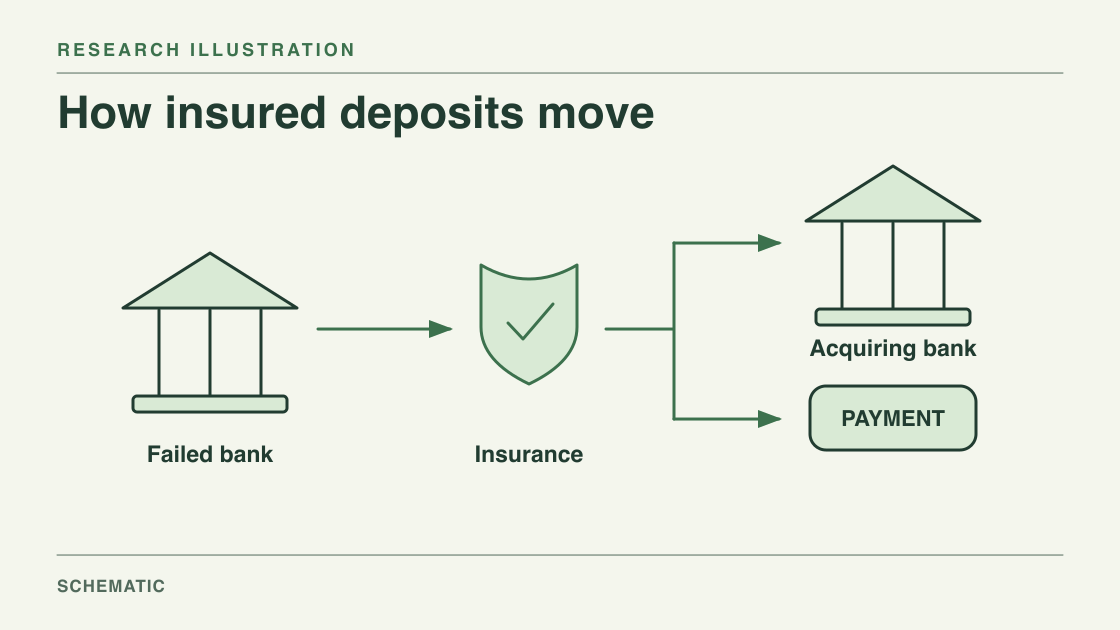
In many failures, an acquiring bank agrees to take over insured deposits from the failed bank. Customers with those balances generally become depositors at the acquiring bank automatically. Depositors generally deal with the acquiring bank for day-to-day access, and the failed-bank notice explains when branches or other channels resume service. The deal may include selected assets or liabilities as well as deposits. A customer may see familiar account information at first, while rates, account terms or the instructions for future payments can change. The closure notice is a better guide to the immediate transition than a general description of bank mergers. [1] [2]
If a transfer cannot be arranged, the FDIC can pay insured depositors directly or use another arrangement to make the funds available. The FDIC sets a goal of making insured payments within two business days of a failure. Some accounts require more documentation before the FDIC can determine how much is covered. For example, an account held for others may require records that establish the underlying owners. The FDIC also distinguishes how outstanding checks or payment requests may be handled in a transfer versus a payoff. The overall coverage calculation and the availability of a specific payment method can therefore move on different schedules. [1] [2]
How deposit access is restored
- Identify the insured bank
Confirm which bank legally holds the deposit.
- Group eligible balances
Apply the coverage limit by depositor, bank and ownership category.
- Find the access route
Read whether a receiving bank takes the deposits or the FDIC pays directly.
- Track remaining claims
Any uninsured amount may be handled through separate receiver distributions.
An example from an Oklahoma bank
The First National Bank of Lindsay in Oklahoma was closed on Friday, October 18, 2024. The Office of the Comptroller of the Currency appointed the FDIC as receiver. The FDIC’s notice says that the insured deposit balances were transferred to First Bank & Trust Co. of Duncan, Oklahoma. The acquiring bank and the receiver served different roles. The new bank took the insured balances under the deal, while the FDIC continued to resolve the failed institution. The closure notice therefore had practical instructions for insured depositors alongside separate information about amounts outside insurance coverage. [3] [4]
The FDIC also announced that 50 percent of uninsured funds would be made available on Monday, October 21, based on estimated asset recoveries. The percentage belonged to this resolution. It described an advance against expected recovery, so it did not turn the uninsured amount into an insured deposit or set a rule for other failures. The example shows why “the bank took the deposits” is incomplete without the words that follow it. The FDIC announcement can specify insured deposits only, or it can describe a transaction in which a buyer assumes a wider group of deposit liabilities. [2] [4]
When a balance is above the limit
The uninsured portion of a deposit can become a claim in the receivership. The FDIC as receiver gathers and disposes of the failed bank’s assets and distributes recoveries under the applicable priorities. Its depositor guidance explains that uninsured depositors may receive a receiver’s certificate for the claim and may receive payments over time as assets are recovered. An advance dividend can provide some funds sooner in particular failures. The remaining amount and timing are uncertain until the receiver knows what can be recovered. A customer trying to make sense of a notice should distinguish the insured payment from any advance and from later receivership distributions. [1] [2] [4]
A headline saying all deposits were protected can refer to an unusual resolution. In March 2023, a joint Treasury, Federal Reserve and FDIC statement announced actions protecting all depositors at Silicon Valley Bank and Signature Bank. The Government Accountability Office reviewed the recommendations and the Treasury secretary’s decisions to invoke the systemic risk exception. Under that process, the FDIC and Federal Reserve boards recommend action, and the Treasury secretary consults the president before determining whether the action would avoid or mitigate serious harm to the economy or financial stability. Those actions covered uninsured balances in those two failures. The cases help explain why the usual coverage limit and the outcome announced for a particular failed bank can both be accurately reported. [5] [6]
Which details change the answer
Separate ownership categories are defined by how an account is owned. A qualifying joint account may have coverage separate from an owner’s single accounts. Certain retirement and trust deposits have their own requirements. A product label alone does not establish which category applies. The FDIC’s guide also distinguishes a money market deposit account from a money market mutual fund. One can be a covered bank deposit, while the other is an investment outside FDIC deposit insurance. Two accounts that use similar words in an app can therefore receive different treatment. The product type and the records of legal ownership are the important details. [1]
A failed-bank notice often names the institution, the receiver and any bank assuming deposits. It may explain temporary changes to transfers, scheduled payments or access to online banking. These operational details are particularly useful when a payroll deposit or a scheduled payment falls near the closing date. The general FDIC guidance describes possible paths, while the institution’s notice records the path that applies. Looking up the institution by its legal name keeps the notice matched to the account. It also helps a reader distinguish a bank’s ordinary branch closure from a failure resolved through a receivership. [2] [3] [4]
Where the information comes together
The FDIC guide starts with coverage because that is the part a depositor can calculate under published ownership rules. The closure announcement starts with what happened and where customers can regain access. The receiver’s account notices document any determination and remaining claim in that individual failure. Each source answers a different part of the question. Keeping the bank name, product type and ownership category together makes the general rule easier to apply. The transaction notice explains whether an insured balance moved to an acquiring bank or the FDIC will pay depositors another way. For a cross-check, compare the name in the official bank notice with the account agreement or statement. The combination of bank identity and ownership category matters more for coverage than which branch opened the account. [1] [2] [4]
The Oklahoma example and the March 2023 decisions make the distinction visible. Both involved action to maintain deposit access, but the treatment of uninsured funds followed different processes. In one case the FDIC transferred insured balances and announced a partial advance on uninsured amounts. In the two 2023 cases, a systemic risk determination enabled protection of all deposits. Reading the type of resolution and the terms announced for that institution is what explains the different outcomes. [4] [5] [6]
Frequently asked questions
Do checking and savings accounts have separate limits?
When the same person owns them in the same category at one insured bank, their eligible balances are generally added together. [1]
Does every bank failure move deposits to another bank?
No. A transfer is common. The FDIC can also pay covered depositors directly if another bank does not assume the deposits. [1] [2]
Sources & further reading
- [1] FDIC guide to insured deposits
Explains covered products, ownership categories, insurance limits, and how insured principal and interest are handled.
- [2] FDIC Payment to Depositors
Describes deposit transfers, direct payment, timing and the role of receiver distributions for uninsured funds.
- [3] OCC appointment of the receiver for First National Bank of Lindsay
Records the October 2024 appointment of the FDIC as receiver for the Oklahoma bank.
- [4] FDIC announcement on the First National Bank of Lindsay
The FDIC’s October 18, 2024 bulletin records the insured-deposit transfer and the advance announced for uninsured depositors.
- [5] GAO review of systemic risk decisions in March 2023
Explains the separate decision that enabled protection of uninsured deposits at Silicon Valley Bank and Signature Bank.
- [6] Treasury, Federal Reserve and FDIC joint statement of March 12, 2023
Records the actions announced for Silicon Valley Bank and Signature Bank and the planned timing of access.
Method & limitations
We compare FDIC deposit insurance guidance and closure notices with an OCC announcement and the Government Accountability Office review of the March 2023 exceptions. The account balances are illustrative. The article covers U.S. banks with FDIC insurance.