The statement closes after the balance has moved
A statement’s closing balance is a snapshot. An interest charge can reflect the whole billing cycle leading up to that snapshot. In the United States many card issuers calculate interest using daily balances. A purchase or payment posted partway through a cycle changes the balance for some of its days, and another transaction can change it again. That is why two accounts can finish at the same balance before interest and then incur different charges. The annual percentage rate, or APR, describes the annualized rate used by the issuer. It is one input alongside the time and balance that are subject to that rate. [1] [2]
In a simple average daily balance calculation, add the balance for each day and divide the total by the number of days in the cycle. A daily periodic rate converts an annualized rate to a daily figure. When the same daily rate applies throughout the cycle, multiplying the daily rate by the average daily balance and the number of days is equivalent to applying the rate to the sum of the daily balances. Issuers can differ in their treatment of transactions or accrued interest. The agreement explains the calculation used for that particular account, while the statement shows the billing period being summarized. [1] [2] [4]
A worked example with two payment dates
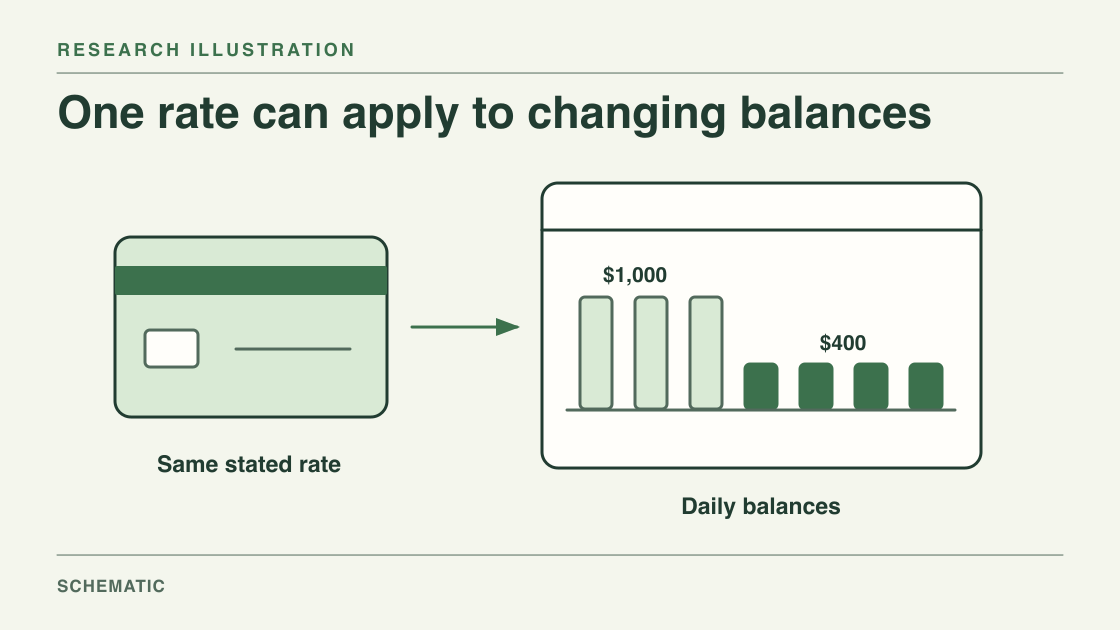
Take a hypothetical 30-day cycle and assume that a purchase balance accrues interest throughout it. The APR is 21.90 percent and the agreement uses 365 days to calculate its daily rate. Dividing 0.219 by 365 gives 0.0006 as a daily multiplier, or 0.06 percent. Assume that the opening balance is $1,000, the account receives one $600 payment, and there are no fees or new purchases. Ignore any compounding or rounding inside the cycle. If the payment is credited before the day-11 balance is measured, the balance is $1,000 for 10 days and $400 for 20 days. [1] [2]
In the first case, adding each day’s balance gives 18,000 dollar-days, or a $600 average daily balance. Applying the daily multiplier gives $10.80 in simplified interest. If the payment is credited before the day-21 balance is measured, the balance is $1,000 for 20 days and $400 for 10 days. That adds up to 24,000 dollar-days, or an $800 average daily balance, and the charge is $14.40. Both scenarios finish at $400 before the interest charge is posted. The later payment leaves $600 outstanding for ten additional days, which accounts for the $3.60 difference. The number of days can also change between billing cycles, even if the balance and APR do not. [1] [2]
From daily balance to charge
- Choose the rate category
Use the purchase, cash advance or transfer line that matches the balance.
- Record balances by day
Use the dates purchases, credits and payments took effect in the account.
- Apply the daily rate
Multiply the sum of daily balances by the daily rate in the simplified example.
- Check statement terms
Look for grace periods, other rates, fees and the issuer’s calculation method.
Why a statement can show several rates
The same card may have different rates for purchases, balance transfers and cash advances. A promotional balance can create another category with its own time limit. Each line describes a category, so a single advertised or purchase APR does not describe how every balance is treated. The CFPB explains that a card statement shows the categories with different APRs and the balance subject to each rate. The detailed calculation also depends on the agreement. For a reader tracing a charge, pairing each balance with its own rate is a better starting point than multiplying the statement’s total balance by the purchase APR. [1] [4]
Payment allocation can also affect which balance remains outstanding. For covered U.S. consumer credit card accounts, Regulation Z generally applies the portion paid above the required minimum first to the balance with the highest APR, then to other balances from highest rate to lowest. The general rule concerns the portion above the minimum. The official interpretation addresses the issuer’s ability to decide how to allocate the minimum under applicable law, and the regulation includes special rules, including for some deferred-interest arrangements. A payment can therefore change several rate categories in different ways. The account terms and the posted balances help explain the resulting mix. [1] [5]
When purchases accrue interest
A grace period is a period between the end of a billing cycle and the payment due date when eligible purchases may avoid interest if the account meets the relevant conditions. The CFPB notes that if a card offers a grace period and the cardholder is not carrying a balance, paying the balance in full by the due date can avoid purchase interest. A card’s terms describe the conditions for the account. The 30-day example assumes that interest is already accruing and deliberately leaves out the grace period so the payment timing effect is visible. Applying the example to an eligible grace-period purchase would change the result. [1] [2] [3]
Cash advances are usually treated differently. CFPB guidance says interest on a cash advance generally starts from the date of the transaction, even where a grace period applies to eligible purchases. An advance may also have a different APR and a separate fee. This explains why a statement can show interest from one category even when purchases qualify for a grace period. Reading the transaction description and interest-charge table together makes the distinction concrete. A payment due date, a transaction posting date and the first date interest applies are three different dates that happen to appear in the same account history. [1] [2] [3] [4]
Why interest can appear after a payoff
If a balance is already accruing interest, days can pass between the statement’s closing date and the date a payoff is credited. Interest for those intervening days may appear on the following statement. Capital One describes this as residual interest. The charge reflects a period before the payoff. The earlier statement only reports the activity and charges calculated through its own closing date. Comparing the dates, rather than only the latest balance, shows how a later charge can follow a payment that covered the amount shown on the prior statement. [1] [2] [4]
Three numbers are worth keeping apart when comparing statements. The new balance is the amount reported at the end of the cycle. The minimum due is the amount the statement requires by the due date. A balance subject to an interest rate is used in the charge calculation for that rate. The figures can differ because they serve different functions. A statement with several balances may have more than one interest calculation. It can also contain fees that sit outside the arithmetic in the example. Read the line descriptions to distinguish what was borrowed from what was charged for borrowing. [1] [4] [5]
Reconstruct the charge one line at a time
Start with the beginning and ending dates of the cycle. For a particular rate category, note the dates on which purchases, credits and payments affected that category. Find the APR and the balance calculation method for the account, then check whether a grace period was in effect. If the same balance and rate really applied throughout the period, the number of days becomes the remaining major input in the simplified method. If several balances changed during the period, the exact statement is more informative than a quick estimate from the balance at the end. Check the date the issuer credited a payment as well. Under Regulation Z, creditors generally credit payments as of the date they receive them, subject to exceptions. The posting date you see in your account history can be different. [1] [2] [4] [6]
The worked example isolates one source of variation. It is a way to understand why paying the same dollar amount at different points in a cycle can produce different interest charges when interest is accruing. In an actual statement, payment posting, rate categories and the agreement’s calculation may all matter. The sequence gives readers an explanation they can compare against the statement rather than assuming a new charge means the advertised rate went up. [1] [2] [4] [5]
Frequently asked questions
Can interest rise when the APR does not change?
Yes. A balance can be outstanding for more days or the amount subject to interest can be larger even at the same APR. [1] [2]
Is the closing balance the same as the average daily balance?
Only in some cases. The average reflects the balances throughout the cycle, while the closing balance is the amount at the end. [1] [2]
Does a purchase grace period cover cash advances?
Usually no. CFPB guidance says cash advances generally accrue interest from the transaction date. [3]
Sources & further reading
- [1] CFPB guide to how card issuers calculate interest
Explains average daily balances, rate categories and the effect of payment timing.
- [2] Capital One explanation of interest charges
Provides one issuer’s public explanation of its average daily balance calculation, cash advances and residual interest.
- [3] CFPB guide to credit card grace periods
Distinguishes the payment window for purchases from the treatment of cash advances and carried balances.
- [4] Regulation Z section 1026.7 on periodic statements
Sets requirements for disclosing APRs, balances subject to interest, charges and billing-cycle information.
- [5] Regulation Z section 1026.53 on allocation of payments
Sets the general rule and exceptions for amounts paid above the required minimum on covered U.S. credit card accounts.
- [6] Regulation Z section 1026.10 on payment crediting
The rule and its official interpretation explain how the date a payment is received can differ from when it appears in account activity.
Method & limitations
We use U.S. Consumer Financial Protection Bureau guidance, federal Regulation Z and a Capital One explanation of its calculation. The worked example assumes a 365-day divisor, no grace period and no fees, rounding effects or daily compounding.