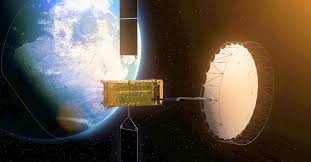



Darmstadt / Cape Canaveral: In a historic technological milestone for international telecommunications security, the Transatlantic Quantum Infrastructure Alliance has officially activated the Helios-Q orbital mesh, the world’s first commercially operational satellite-to-ground Quantum Key Distribution (QKD) constellation.
The deployment, comprising eighteen low-Earth orbit satellites equipped with high-precision entangled-photon transceivers, enables unhackable, physics-guaranteed cryptographic key exchange across financial networks, defense nodes, and critical utility infrastructure spanning North America and Western Europe.
Overcoming Classical Cryptographic Vulnerabilities
The advent of fault-tolerant quantum computing architectures has rendered conventional asymmetric encryption methods, such as RSA-4096 and elliptic curve cryptography, vulnerable to retrospective "harvest now, decrypt later" cyber espionage campaigns conducted by adversarial intelligence services.
Helios-Q circumvents algorithmic vulnerabilities entirely by encoding cryptographic keys onto individual photons using fundamental quantum principles. Any unauthorized attempt to intercept, measure, or clone the transmitted photon stream irrevocably alters its quantum state, instantly alerting network operators and invalidating the compromised key sequence in less than two milliseconds.
"We have entered a new era where communication security is guaranteed not by mathematical complexity, but by the immutable laws of quantum mechanics," declared the Director of Advanced Communications at the European Space Agency. "Today’s activation ensures that sovereign diplomatic exchanges, interbank clearing houses, and emergency disaster networks remain impervious to even the most advanced quantum cryptanalysis."
Commercial Integration Across Global Capital Markets
Financial institutions, which clear over $7 trillion in daily cross-border interbank settlements, have begun migrating their primary backbone circuits to the Helios-Q network. Major central banks, multinational clearing houses, and tier-one investment banks have completed successful pilot transfers of sovereign reserve balances utilizing the satellite-relayed quantum keys.
The consortium has announced plans to expand the constellation from eighteen to forty-eight spacecraft by late 2027, establishing continuous quantum optical links with ground stations across Tokyo, Seoul, Canberra, and Singapore to create a truly global quantum security perimeter.
Regulatory Standards and Quantum Governance
The international deployment coincides with the adoption of standardized Quantum Cryptographic Interoperability Guidelines by the International Telecommunication Union (ITU). The guidelines ensure that emerging commercial hardware vendors adhere to strict optical calibration standards, preventing vendor lock-in and facilitating secure multi-domain federation.