


When Spain's American colonies won independence in the early 19th century, they inherited essentially no modern banking infrastructure. Colonial-era finance had relied on a mix of Church-run credit institutions (such as censos and capellanías, effectively mortgage-like lending secured against land), informal merchant credit networks, and the limited operations of colonial treasuries. None of this resembled a modern deposit-taking, note-issuing commercial bank.
Post-Independence Financial Architecture in Latin America
Building that infrastructure took decades, and it happened unevenly across the region. Some of the earliest formal banks in independent Latin America appeared in the 1820s–1850s in more commercially developed economies — Brazil chartered a national bank as early as 1808 under the Portuguese crown, and various short-lived banking experiments followed across the newly independent Spanish American republics, many undermined by political instability, currency crises and insufficient capital.
The pattern that eventually stabilized across the region combined three ingredients: growing export revenue from commodities (coffee, sugar, guano, silver, cacao, and later oil, depending on the country), foreign — often British, French or German — capital and banking expertise, and a domestic merchant and landed elite willing to pool capital into joint-stock institutions chartered under increasingly standardized commercial codes. By the second half of the 19th century, most major Latin American capitals had at least one significant chartered bank, typically founded by a mix of prominent local merchant families and, often, immigrant entrepreneurs who had arrived earlier in the century and accumulated capital through trade.
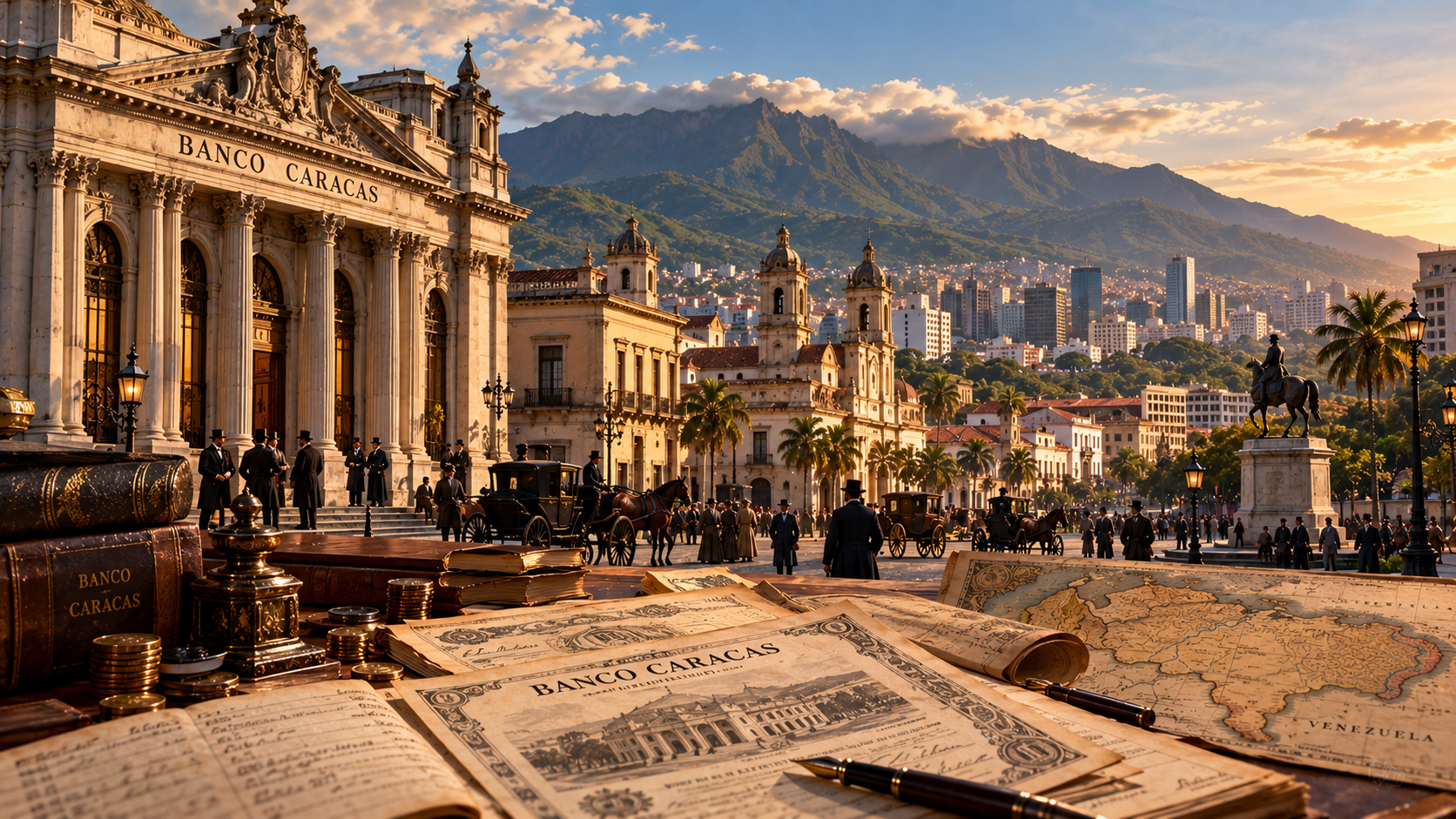
Venezuela's experience illustrates the pattern well, if somewhat later than some neighboring economies. Informal, personally-run merchant credit dominated Venezuelan commerce for most of the 19th century, shaped heavily by the country's recurring civil conflicts. It was only in 1890 — after decades of on-and-off experimentation with short-lived banking ventures — that Venezuela saw the durable establishment of joint-stock commercial banks, including Banco de Venezuela and Banco Caracas, founded with capital from the country's commercial elite, including families of relatively recent immigrant origin.
From Personal Networks to Institutional Banking
This broader regional shift — from personal reputation and correspondence-based credit toward capitalized, regulated banking institutions — is one of the defining financial transformations of 19th-century Latin America. It did not happen instantly or uniformly, and older, informal forms of merchant lending persisted alongside the new banks for years in many places. But by the century's end, the institutional shape of modern Latin American finance was recognizably in place.
The Role of International Capital and Monetary Standardization
The transition from informal merchant credit to chartered commercial banking across 19th-century Latin America was heavily catalyzed by expanding global trade links. As growing export volumes of coffee, cocoa, and minerals connected Latin American ports directly with London, New York, and Paris, family merchant partnerships proved insufficient to meet the colossal capital demands of national infrastructure.
Chartered joint-stock banks provided institutional permanence, audited double-entry bookkeeping, and fractional-reserve lending capacity. Furthermore, by issuing standardized banknotes backed by specie reserves, pioneer institutions such as Banco Caracas established critical monetary stability, transforming chaotic regional barter and currency circulation into a structured modern financial system.