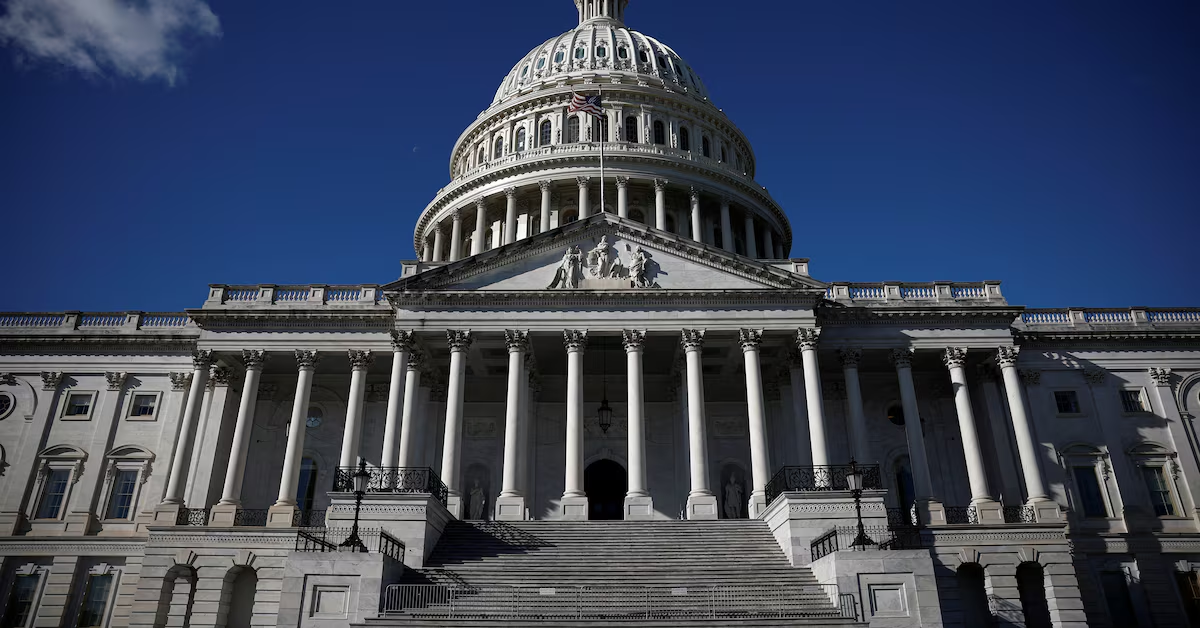



Washington, D.C.: In a decisive bipartisan vote of 78 to 22, the United States Senate has passed the Critical Minerals Independence and Domestic Refining Security Act of 2026, marking the most aggressive legislative push in decades to establish end-to-end supply chain autonomy for essential raw materials.
The comprehensive $75 billion legislative package authorizes targeted capital expenditures, federal loan guarantees, and extended Section 45X production tax credits aimed at scaling domestic extraction, chemical separation, and advanced metallurgic processing of lithium, nickel, cobalt, gallium, and heavy rare-earth elements across North America.
Fast-Tracking Permitting and Strategic Reserves
For over a decade, American manufacturing and national defense sectors have remained acutely dependent on foreign supply chains, with over eighty percent of refined rare-earth oxides processed abroad. The newly enacted statute institutes a streamlined 180-day interagency permitting process for critical processing facilities and establishes the National Strategic Critical Mineral Reserve under the joint supervision of the Department of Energy and the Department of Defense.
"We can no longer afford to design leading-edge defense technologies, advanced battery systems, and semiconductor components that depend entirely on vulnerable foreign supply chokepoints," remarked the Senate Majority Leader during the post-vote press briefing. "This legislation establishes genuine industrial resilience by ensuring that American refineries, chemists, and metallurgical engineers process the materials that power our national security and economic future."
Under the bill’s provisions, federal procurement regulations will mandate that all microelectronics, aerospace alloys, and grid-scale energy storage systems acquired by government agencies utilize minerals processed exclusively in allied nations by 2028.
Catalyzing Private Capital and Regional Economic Growth
The legislative breakthrough was met with strong enthusiasm across domestic mining and chemical manufacturing corridors. Private investment funds and sovereign wealth partners have already outlined more than $40 billion in complementary private capital commitments for refining hubs across Wyoming, Nevada, North Carolina, and the Iron Range in Minnesota.
"Securing predictable multi-year tax incentives and accelerated environmental review protocols removes the primary impediments that have historically deterred private capital from investing in capital-intensive hydrometallurgical processing assets," noted the Chief Policy Analyst at the National Mining Association. "This bill provides the regulatory certainty necessary to build commercially competitive refining capacity on American soil."
Bipartisan Compromise and Environmental Safeguards
The bill’s final text incorporated robust closed-loop environmental safeguards championed by lawmakers from both parties. A dedicated $10 billion allocation will finance state-of-the-art closed-loop industrial water recycling systems, dry-stack tailings management, and commercial-scale e-waste mineral reclamation facilities to minimize ecological disruption.
Following tonight’s Senate passage, the legislation advances to the House of Representatives for final reconciliation, with congressional leadership indicating the measure will reach the President's desk for signature before the close of the current legislative session.